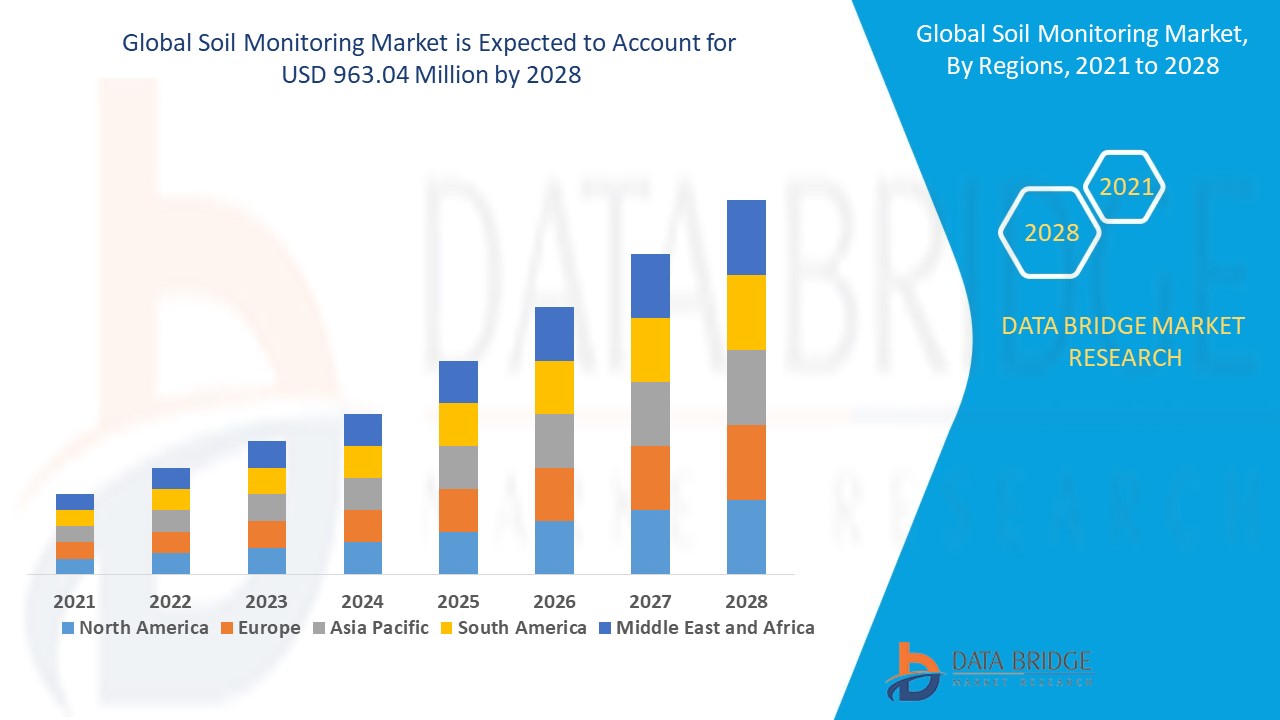
"**Soil Monitoring Market Size And Forecast by 2028**
The study also emphasizes the broader implications of the strategies employed by these companies on the Soil Monitoring Market. Their innovations and market contributions not only shape the industry today but also pave the way for its future trajectory. By analyzing these companies, the report equips stakeholders with actionable insights to understand competitive positioning, identify growth opportunities, and devise strategies to thrive in this dynamic and evolving market landscape.
Soil monitoring market size is valued at USD 963.04 million by 2028 is expected to grow at a compound annual growth rate of 12.30% in the forecast period of 2021 to 2028.
Get a Sample PDF of Report - https://www.databridgemarketresearch.com/request-a-sample/?dbmr=global-soil-monitoring-market
Which are the top companies operating in the Soil Monitoring Market?
The Top 10 Companies in Soil Monitoring Market include leading firms. These companies are known for their strong market presence, innovative products, and ability to meet customer demands. They continue to drive growth in the industry through their commitment to quality and innovation, making them key players in the Soil Monitoring Market.
Segments
- Technologies: The soil monitoring market can be segmented based on technologies such as remote sensing, real-time monitoring, telematics, and Internet of Things (IoT). Remote sensing technology enables the collection of vital data from a distance, ensuring the efficient monitoring of soil quality and conditions. Real-time monitoring provides up-to-the-minute information on various soil parameters, enabling prompt actions to be taken. Telematics allows for the transfer of data over long distances, enhancing connectivity in soil monitoring systems. IoT solutions integrate sensors and devices to gather comprehensive data on soil health, enabling advanced analytics for better decision-making.
- Applications: The market can also be segmented based on applications, including agriculture, construction, environmental monitoring, research, and others. In agriculture, soil monitoring is crucial for optimizing crop yield, reducing water usage, and ensuring sustainable farming practices. In construction, monitoring soil conditions ensures the stability and safety of structures. Environmental monitoring involves assessing soil quality to prevent pollution and preserve ecosystems. Research applications focus on studying soil characteristics to enhance scientific understanding and develop innovative solutions.
- End-Users: End-user segments in the soil monitoring market include farmers, agricultural cooperatives, construction companies, environmental agencies, research institutions, and others. Farmers utilize soil monitoring technologies to improve crop production, conserve resources, and mitigate environmental impact. Agricultural cooperatives leverage soil monitoring for collective farming initiatives and data-driven decision-making. Construction companies rely on soil monitoring to assess site suitability and manage risks during building projects. Environmental agencies use soil monitoring to enforce regulations, monitor pollution levels, and protect natural habitats. Research institutions employ soil monitoring for academic studies and innovation in soil science.
- Market Players*
- Davis Instruments
- Spectrum Technologies
- Sentek Technologies
- Decagon Devices
- ICT International
- Geoprospectors
- Campbell Scientific
- E.S.I. Environmental Sensors